
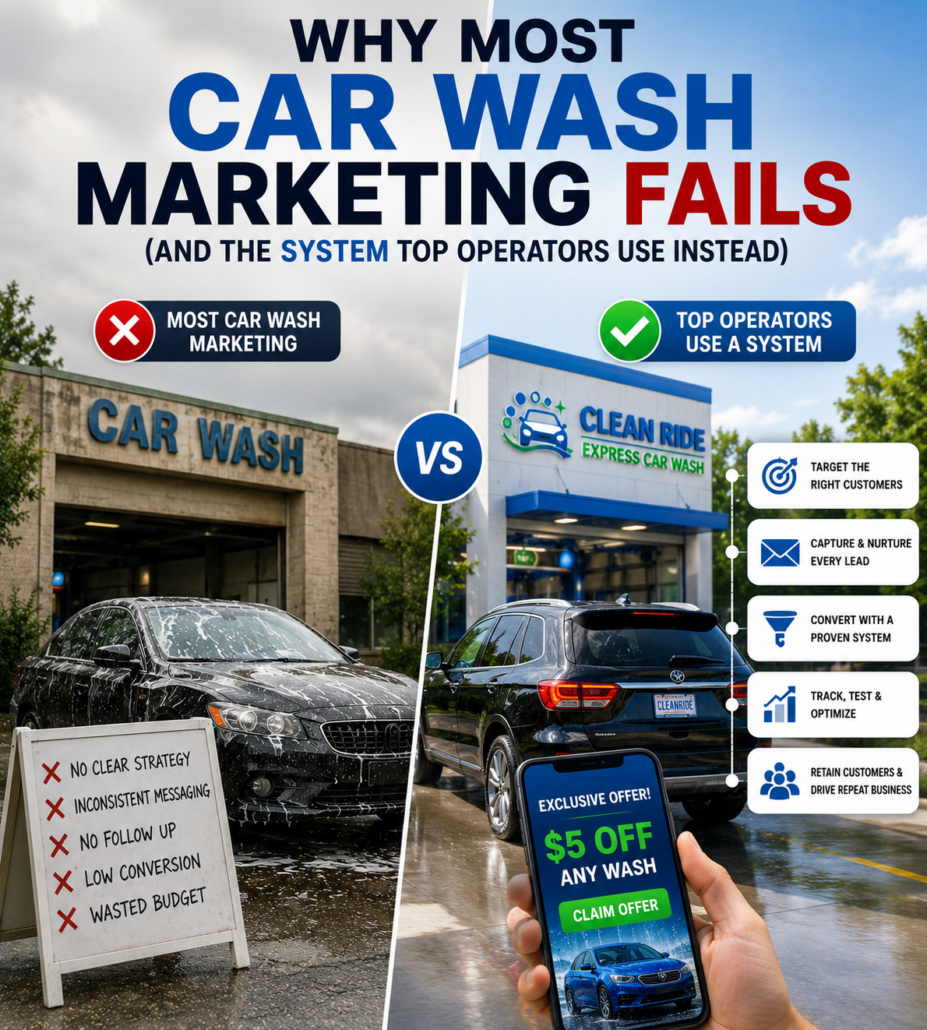
Why Most Car Wash Marketing Fails (and the System Top Operators Use Instead)
Many car wash owners assume marketing is the problem when sales slow down. In reality, the issue usually is not a lack of effort. It is a lack of system.
One month they run a Facebook ad. The next month they post a few specials on Instagram. Then they print flyers, try a discount, and hope traffic picks up. This kind of stop-and-start promotion may create short bursts of attention, but it rarely builds predictable growth. That is why so many car wash marketing campaigns feel busy without producing steady revenue.
The operators who grow consistently do something different. They do not rely on random tactics. They use a structured system that turns local attention into repeat customers.
Why car wash marketing fails
Most car wash marketing fails because it focuses only on getting people in once. A discount might bring in a few first-time customers, but if there is no follow-up, no retention plan, and no long-term visibility strategy, that customer often disappears as quickly as they arrived.
Another major issue is inconsistency. Many owners market only when business is slow. That creates a cycle where traffic rises briefly, then drops again once marketing stops. Instead of building momentum, they keep restarting from zero.
A third problem is weak positioning. If every message sounds like “best wash in town” or “great prices,” customers have no real reason to remember one business over another. Generic marketing blends in, especially in competitive local markets.
The hidden cost of random promotions
Discount-heavy marketing trains customers to wait for the next deal. That can hurt margins and make it harder to build loyalty.
It also creates unstable revenue. When promotions become the main strategy, the business becomes dependent on constant offers rather than brand trust, convenience, service quality, and customer experience. Over time, this makes growth harder to sustain.
Random marketing also wastes time. Owners and managers put effort into posts, ads, and campaigns, but without a system to capture data, follow up, and bring customers back, there is no compounding return.
The system top operators use
Top-performing car wash operators tend to build their marketing around five connected parts:
1. Local visibility
First, they make sure the business is easy to find. That includes strong branding, clear roadside messaging, active local search presence, consistent social media, and offers that match customer needs.
The goal is simple: stay visible in the market so drivers think of your wash when their car needs attention.2. First-visit conversion
Getting attention is not enough. Top operators focus on converting nearby drivers into first-time customers through strong introductory offers, seasonal campaigns, fleet or community partnerships, and clear reasons to choose their wash over competitors.
This step matters because traffic without conversion is wasted attention.
3. Customer capture
The best operators do not let one-time visitors stay anonymous. They collect customer information through memberships, loyalty programs, text clubs, email offers, app signups, or receipt-based incentives.
This creates an owned audience. Once you can reach customers directly, you no longer depend only on ads or drive-by traffic.
4. Retention and reactivation
This is where most car washes lose revenue. A customer comes in once, has a decent experience, and never hears from the business again.
Top operators solve this with automatic follow-up, membership offers, reminder texts, bounce-back promotions, weather-based campaigns, and customer appreciation messages. Instead of constantly chasing new traffic, they increase visit frequency from people who already know the brand.
5. Performance tracking
Strong operators measure what is working. They track offer performance, membership growth, repeat visits, customer acquisition sources, and revenue by campaign.
Without this step, marketing becomes guesswork. With it, decisions get sharper and budgets get smarter.
What this looks like in practice
A weak car wash marketing strategy might look like this:
– Run a discount ad once in a while.
– Post on social media only when business is slow.
– Offer no membership follow-up.
– Collect little or no customer data.
– Rely mostly on price to win customers.
A stronger strategy looks like this:
– Stay visible every week with consistent local messaging.
– Use one clear first-time customer offer.
– Capture customer contact information at the point of sale.
– Promote memberships and return visits.
– Track results and improve over time.
The difference is not just creativity. It is structure.
Why the system works better
A system works because it connects marketing to revenue, not just attention. It gives each campaign a job to do.
Some marketing should create awareness. Some should drive a first visit. Some should sell memberships. Some should bring back inactive customers. When every message has a clear role, results become easier to predict and improve.
That is what separates top operators from businesses that stay stuck in promotion mode. They stop asking, “What should we post today?” and start asking, “What part of the customer journey needs support?”
Imagine two car washes in the same area.
Car Wash A runs occasional discounts and gets spikes of traffic. Car Wash B promotes a first-wash offer, encourages every customer to join a membership or text club, sends reminders before busy weekends, and reactivates inactive customers every month.
Over time, Car Wash B usually builds more predictable revenue because it has a system designed to increase customer lifetime value, not just one-time visits.
If your car wash marketing is not producing steady growth, the answer is not more random ads or deeper discounts. The answer is a better system.
The top operators do not win because they market more loudly. They win because they market more deliberately. They build visibility, convert first-time visits, capture customer data, drive retention, and track performance with consistency.
When those pieces work together, marketing stops feeling like a gamble and starts becoming a growth engine.


